
If you’ve ever trusted the wrong person, this one’s for you.
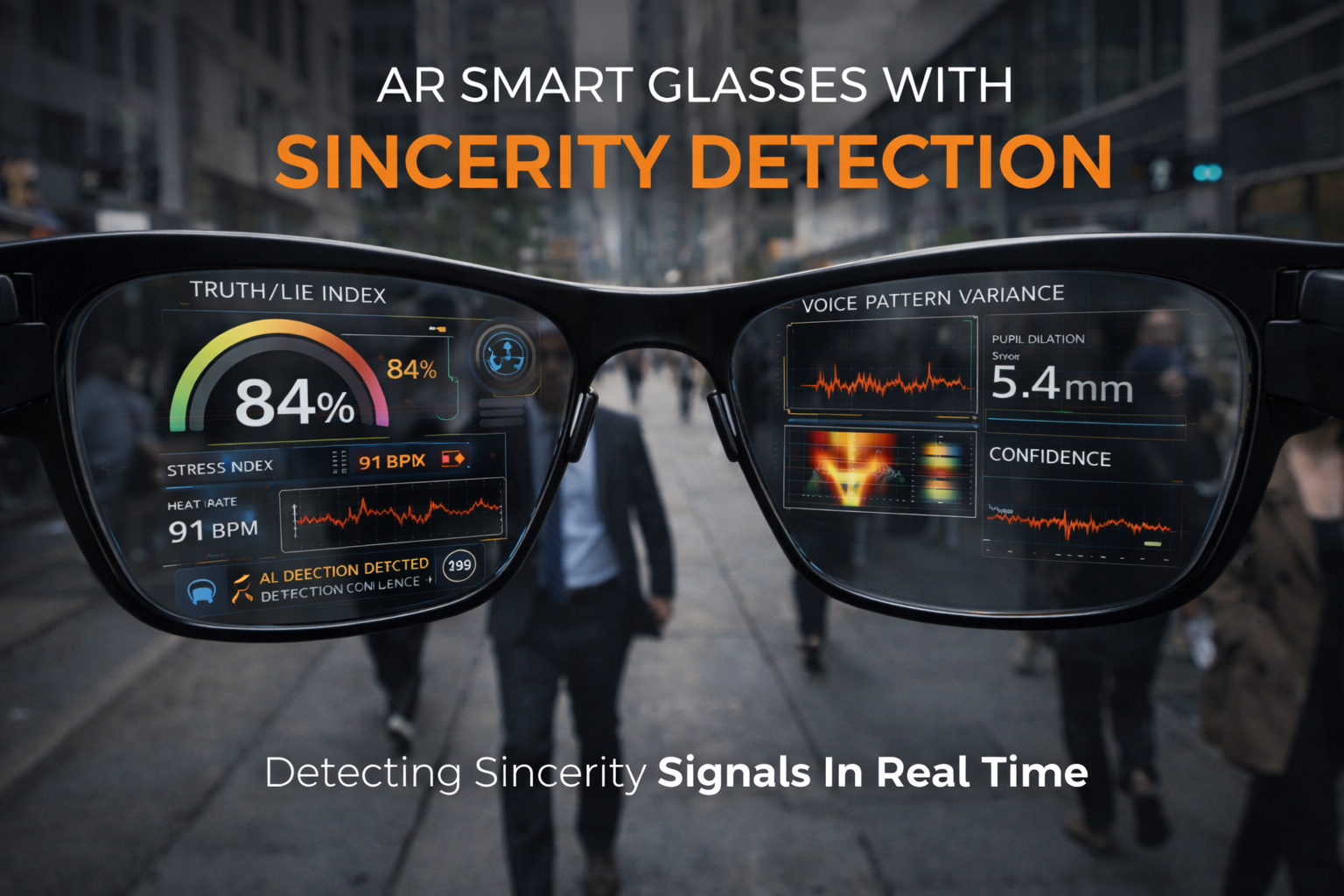
We just published a new video showing AR smart glasses with sincerity detection: live HUD graphs, audio cues, and real-time “something’s off” signals based on what the glasses see and hear. Watch it here: https://www.youtube.com/watch?v=gxgm48AxFTQ
And for the deeper background on the concept: https://veracityintegrity.com/the-future-of-truth-verification-a-revolutionary-consumer-device-for-sincerity-detection/
This is an ongoing project, and the pace has been excellent. Not “maybe someday” excellent, more like “we’re already holding convincing demos in our hands” excellent. The goal is simple: give normal people better signals before they bet their time, money, or trust.
The problem we’re solving
Everybody’s been burned. In business deals, relationships, hiring, sales calls, even basic everyday interactions. The issue is not that people are stupid. The issue is that humans are easy to manipulate when someone is confident, charming, or practiced.
Traditional polygraphs try to measure physiological responses, but they’re not exactly plug-and-play, and they’re not treated as infallible. Even Veracity Integrity’s own write-up calls out long-standing limitations like dependence on exam conditions and human interpretation, plus the reality of false positives and negatives.
So we’re taking a different route: consumer-grade, AI-assisted sincerity detection, delivered in a way that fits real life.
The concept: phone brain, glasses HUD
Veracity Integrity’s post describes a portable sincerity detection concept that captures cues like voice patterns, micro-expressions, and heart rate variability, then processes them with AI and returns an assessment quickly.
For our video and current build direction, we’re aiming at a more modern, wearable flow:
- Your phone runs the heavy analysis
- AR smart glasses display the results
- You get visual graphs plus optional audio cues
- The interface stays subtle, because nobody wants to look like RoboCop at a coffee shop
Think of it as: “an extra layer of situational awareness,” not “a magic truth gun.”
What the viewer sees in the video
The demo experience is intentionally simple:
- The wearer walks through normal environments (city sidewalk, crowds, day-to-day movement).
- Inside the lenses, a clean HUD shows a few key metrics.
- The graphs update as people approach, pass, and move away.
- In some moments, light “target brackets” briefly lock on to someone nearby, then release.
- Audio cues can optionally ping when signals spike (stress, mismatch, odd variance).
The key design rule is this: the HUD is inside the lenses, like a waveguide display, not floating in midair. That matters because it feels real, not like a gimmick.
What we measure (and what we don’t pretend to measure)
Let’s be blunt: this is not a mind reader. It’s not perfect. It’s not a courtroom oracle. It’s a decision aid.
The Veracity Integrity concept post focuses on combining multiple inputs to assess sincerity: voice patterns, micro-expressions, heart rate variability, and related indicators. That’s the right direction, because single-signal “lie detection” is where bad ideas go to live.
So our approach is multi-signal and confidence-based:
- “Here are the signals we’re seeing.”
- “Here’s the confidence level.”
- “Here’s how it changed over time.”
That’s it. No cheesy “LIAR!” overlays. No cartoon alarms. No public shaming. Just data and probability.
The progress so far (this is the part I’m proud of)
This project is moving fast, and not in the fake “we made a logo” way.
We already have:
- A strong visual language for the HUD: readable, clinical, not loud.
- Realistic lens-based overlays that look embedded, not pasted on.
- Multiple scene prototypes (street walking, lab testing, split-screen analytics views, and product close-ups).
- A repeatable production pipeline for generating consistent visuals and sequences.
This is the kind of progress that usually takes teams months of thrashing. We’ve been iterating quickly and tightening the concept with each build.
On the Veracity Integrity side, the platform positioning is also clear: AI-driven truth verification across multiple sectors, with a focus on reliability and ethical use. That matters, because “truth tech” without ethics becomes “surveillance tech” real fast.
Why this can be a consumer product
The Veracity Integrity write-up emphasizes accessibility and affordability as a core goal, essentially democratizing access to sincerity detection so it’s not locked behind high-cost setups.
That’s the right mindset. If this stays “enterprise-only,” it will stay rare, expensive, and gatekept. If it becomes consumer-grade, it becomes something people can actually use in the situations where trust is most often abused.
Use cases that make sense (and don’t require a spy fantasy):
- Vetting a potential business partner before signing something dumb
- Hiring and contractor screening (as one input, not the only input)
- Verifying consistency in high-stakes conversations
- Journalism and source vetting (again, as a signal, not a verdict)
- Personal safety situations where intuition says “nope”
The post also frames broad applications in personal relationships, business, journalism, and education.
A needed warning label
Because adults should be allowed to hear the truth without clutching pearls.
This tech must be used responsibly:
- Consent and legality matter.
- Privacy matters.
- False positives are real.
- Bias and context are real.
- This cannot replace common sense.
Even Veracity Integrity’s positioning leans heavily into ethical and compliant use as part of the brand identity. That’s not optional. That’s the line between useful tool and nightmare gadget.
Where we’re going next
As an ongoing project, our next steps are about turning “cool demo” into “usable product concept”:
- Tighten the HUD to a small set of high-value signals.
- Make the audio cues optional and tasteful (no constant chirping).
- Improve scene-to-scene consistency so the experience feels like one product.
- Keep the user in control: sensitivity settings, logging on/off, privacy modes.
- Continue iterating toward a consumer-ready story: clear benefits, clear limitations, clear ethics.
Watch the video and follow the build
Watch: https://www.youtube.com/watch?v=gxgm48AxFTQ
Project details: https://veracityintegrity.com/the-future-of-truth-verification-a-revolutionary-consumer-device-for-sincerity-detection/
This is not magic and it’s not perfect, but it is a very interesting idea: better signals before you bet your time, money, or trust.